Dressing for the Lens: My On-Camera Wardrobe Rules, Learned Live and the Hard Way
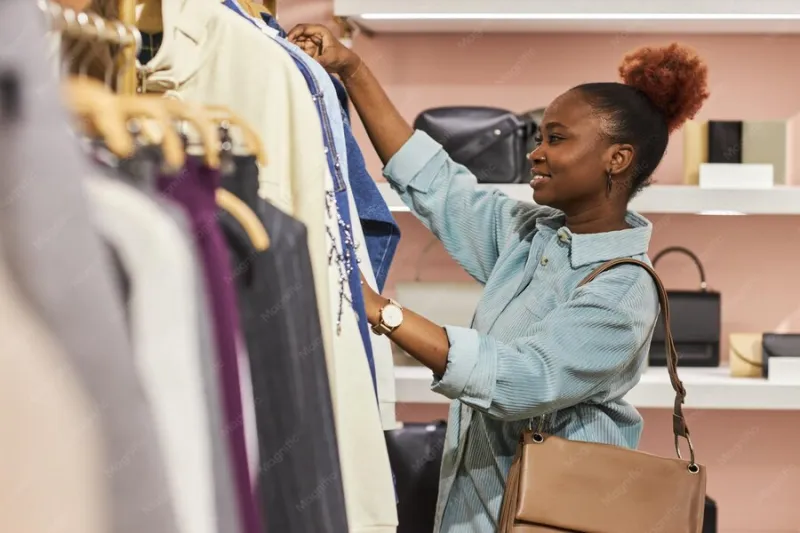
Photo: woman choosing outfits on clothing rack preparing for TV appearance, via img.freepik.com
There's a segment from a morning show appearance a few years back that I hope has been scrubbed from the internet. I wore a black-and-white herringbone blazer — very chic in my mirror, a strobing, eye-watering mess on camera. The pattern fought the camera's sensor the entire three minutes I was on air, and I spent the whole interview looking like a bad TV signal.
Lesson learned. Cameras and closets do not speak the same language, and after enough spots and shoots, I've finally figured out the translation.
Rule One: Solids Are Your Best Friend
Jewel tones are the workhorses of my on-camera wardrobe. Emerald, sapphire, deep magenta — they read rich on video and flatter almost every skin tone. Mid-tone blues are consistently my most reliable pick for morning shows, which is why half my closet now looks like a Pantone swatch book.
Bright white is tricky under studio lights (it glows), and true black can swallow detail, so I aim for the middle of the brightness range. If I need a neutral, I go with camel, navy, or a soft gray instead of stark anything.
Rule Two: The Patterns That Got Me Edited Out
Besides the herringbone disaster, I've had two other outfits die in post. A fine-striped shirt created a moiré effect — those weird wavy lines that appear when a camera can't process a tight pattern — and the editor kindly swapped to a wider shot. And a sequin skirt, which felt so fun at 6 a.m., caught every light in the studio and became a disco ball that distracted from everything I said.
Now my pattern ceiling is: small, low-contrast prints only. Think subtle florals, tone-on-tone textures, a fine knit. Nothing the camera has to work to understand.
The Fit Matters More Than the Fashion
Cameras add weight — that's just physics with a wide-angle lens — but the real trap is clothing that's almost right. A blazer that gaps at the button, a collar that folds weird when you sit, sleeves that swallow your hands during gestures. On camera, you can't adjust your outfit mid-sentence without it becoming A Thing.
I now do a full sit-test, stand-test, and arm-gesture-test before anything leaves my closet for a shoot. If a jacket bunches when I lean forward, it's out. Tailoring is cheaper than a re-shoot, I promise.
My Go-To Formula for TV and Brand Shoots
When I'm packing for an appearance, I build around one reliable formula: a solid jewel-tone top, a structured blazer or jacket in a complementary neutral, and simple bottoms the camera will mostly ignore. One statement earring, nothing that clinks against a lapel mic. Matte makeup, because shine reads as sweat on HD.
And I always — always — pack a backup top. I once had a coffee incident forty minutes before going live, and the spare knit top in my tote saved the segment. Every seasoned TV person I know carries a backup. Now you know why.
The Outfit That Got Me Booked
Funny enough, my most-booked look isn't exciting: a deep green wrap dress, nude heels, gold hoops. It's flattering from every angle, works under any lighting setup, and photographs well for the behind-the-scenes content I post after. Sometimes the winning outfit isn't the one that wows your mirror — it's the one that lets the camera forget about your clothes entirely and focus on what you're actually there to say.